|
World
War II
See also
war
memorial
Much of the information in this section has been taken
from the recollections of local lad
David Dodd, Arthur Bell from the Royal Engineers and
the book "The Memoirs of an Undistinguished Man", by
Captain George Lucas, former owner of Bury House (published 1955).
Geoff Gough remembers sitting in the front room of
his family home, the former Three Horse Shoes
on September the 3rd 1939, the day after his eleventh birthday, listening to
Neville Chamberlain declare war.
David Dodd was a lad aged 6-10 years living at
Frog Island, Rockingham Road during the
War. Says David: "One of my earliest recollections is of going to
the clothing factory with my mother to collect our gas masks. I was most upset
because I was just a bit too old to have a Mickey Mouse one!
I also recall watching a mass practice parachute
jump over the valley. Hundreds of planes dropping thousands of men, it looked
just like it was snowing. We heard later that several of the men were injured,
and some died, as a result of the exercise. Once, a parachute was found in the
field next to the school (in School Lane then). I don't know if the
parachutist was one of ours or from an enemy plane, but the 'chute was quickly cannibalised by us school children, and a few adults, until Mr Porter
(the local headmaster) ordered
us out of the field. The nylon parachute cord (I still have some) was very
useful and I believe the ladies of the village found things to do with
portions of the silk canopy.
"One day we heard rumours that a plane had crashed
somewhere South of East Carlton. A posse of us furiously pedalling our bikes
headed over there but, in fact, the plane hadn't crashed but had landed
relatively unscathed on a farm track ( I think it was the one leading to
Darnell's Lodge). The pilot was there and told us to be sure not to go round
to the front of the plane as he had set the machine guns to fire off all the
ammunition to render the plane safe!
Hilda Lavery (nee Beadsworth) has told us about the fantastic community
spirit that there was during the War: "We used to share everything, pooling
eggs, bacon and so on to make sure that everybody's children had enough to
eat. We didn't waste anything either. If you got a saucepan with a hole in it,
you put a block in it - you didn't throw it away!"
Although Cottingham was
only three miles away from the Corby steelworks (which the Germans knew about
because their engineers had taken part in its construction), the few bombs
that fell in the area fell in open country and not a single house within five
miles of the village was damaged. The closest a bomb got to Cottingham was in
Claypole's field about halfway between the old windmill and the Corby Road. It
made a crater some 10 or 12 feet deep and 20 feet across. It was told at the
time that it was either intended for Corby Steel works or was discharged before
the plane returned to Germany.
The nearby Eyebrook reservoir was used for bombing practice by the Dambusters
before their attack on the German dams. David Dodd recalls: "From
Frog Island we could often see the Eyebrook Reservoir glimmering in the sun, and
aeroplanes dropping flares on to it. We learned later that this was in fact
Wing Commander Guy Gibson and his comrades practicing for the Dambuster raids
over Germany."
Soldiers in the village
During the War, some 45 British
soldiers (from the 9th Armoured Division of the 11th Field Squadron Royal
Engineers?) were billeted in the attics and outbuildings of Bury
House and there were 17 army vehicles parked in the Spinney, which was where
Bury Close now stands. The then owner,
Captain George Lucas, built a bathroom and fitted out a games room for the men,
recalling that, when
an officer from the Military Authorities offered him six shillings and
elevenpence a week in compensation for the billeting, "I marched him
from the property saying that I considered his offer an insult and that under no
circumstances would I accept a penny" Captain Lucas was true to his
word and only profited from a kitchen carpet that the sappers left behind! Later
in the war, a company of Czechs stayed at Bury House. Captain Lucas recalls that
some of the village girls found the Czechs ‘too attentive’.
Soldiers from the squadron were also billeted in
the basement of the clothing factory on Rockingham Road and, in Middleton, at
Burgess House (now Cannam House), in the loft of the adjoining house (then
owned by the Healy family and since demolished) and in the back room of the
Woolpack Inn. For a short time, there were also soldiers staying at Manor Farm
until the then owner, Mrs Hunt, complained!
Sapper Arthur Bell recalls how stone was quarried
from the almost empty stone pit (where Stonepit Drive now stands) to make a
hard standing for newly acquired transport vehicles at the back of Cannam
House. The former Congregational Church on Main Street, Middleton was made
available for the soldiers as a reading room but, being only lit by oil lamps,
was not much used. Arthur also tells us that a Nissen hut was erected next to
the War Memorial which was used for stores and occupied for a time as a
billet. David Dodd remembers watching Italian Prisoners of
War digging the
foundations for a the hut. Says David:
"There were British soldiers standing over them with rifles." David also
recalls tanks practicing on rough terrain in a field on the right hand side out
at the top of Rockingham Road. "One day, a large convoy of tanks came
from Rockingham direction, right past Frog
Island. There seemed to be hundreds of them, taking hours to go by. I
remember the grown-ups complaining what a churned up mess they made of the road.
Evacuees
Captain Lucas refused to accept any evacuees at
Bury House, but there were evacuees staying at Cannam House in Middleton, and
also in the cottages on the right hand side of High Street, where the garages
now stand.
David recalls:
"One day Crane's lorry (the local carrier) arrived
at the old school. About 20 children disembarked. Each one had a parcel tag
attached bearing their name and maybe one or two other details. These were the
evacuees, children from London who were to be absorbed into the local
community away from the blitz. Only a few names come to mind now, 60 years on.
One, however, was Ronnie Witt, who was taken in by a family in Middleton. He
stayed on, whereas most of course returned after the war. There was one called
Sneider whose name was translated to Tailor or Taylor for obvious reasons.
Then there was Harry Farey who could tap dance, sometimes
demonstrating his talents at Social Evenings."
Home Guard
During the second world war, Captain Lucas
organised the Corby Home Guard. However, control soon passed to a director of
the steelworks who already ran a large battalion engaged exclusively in
protecting the works. Captain Lucas then became a Welfare Officer, but
still had
duties to perform, including many cold nights spent on the top floor of the clothing
factory 'firewatching'.
|
|

|
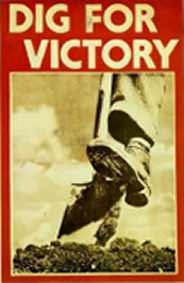
Dig for Victory!
Across the nation, gardens were being turned
over to food production, and Captain Lucas ploughed up the local football field,
which he owned, to grow food. He recalls:
"When
first sown with oats, the weather was dry and the wind cold, and as a result,
wireworms got busy and half an acre was so bare that, answering the appeal for
more green vegetables, I got the local Boy Scouts to hoe up the oats and,
without any assistance, I planted the plot with Brussels sprouts. I tended them
with more than a mother’s care and produced an excellent crop, but not having
any labour available to pluck the sprouts, I sold it by auction and was bid £17
for it.
"The sequel was amusing as, though I had stipulated that the crop must be
off the ground by the end of February, the buyer would not come to get them. I
pressed him to do so and he came, picked one sack and was chased off the ground
by the village policeman. The end came when, after my neighbour’s bullocks had
broken the fences and consumed a large part of the crop, my buyer sold it to
another farmer, and it was consumed by sheep, but only after the second buyer
had cut the sprouts and carted them off the ground.
"After the oats came potatoes
and what a ramp that was - the Government bought at £8 a ton and allowed the
grower to put them on a cart and repurchase at one pound 10 shillings. I did not
know the ropes and was content to accept the price and finish with it, but
another adjoining farmer had 50 acres of good potatoes and made a packet of
money out of it."
|